DMV Practice Test Pro 2026
- 4.7
- Rating
- 500.00K
- Installs
- Free
- Price

 Analysis by App-foxy
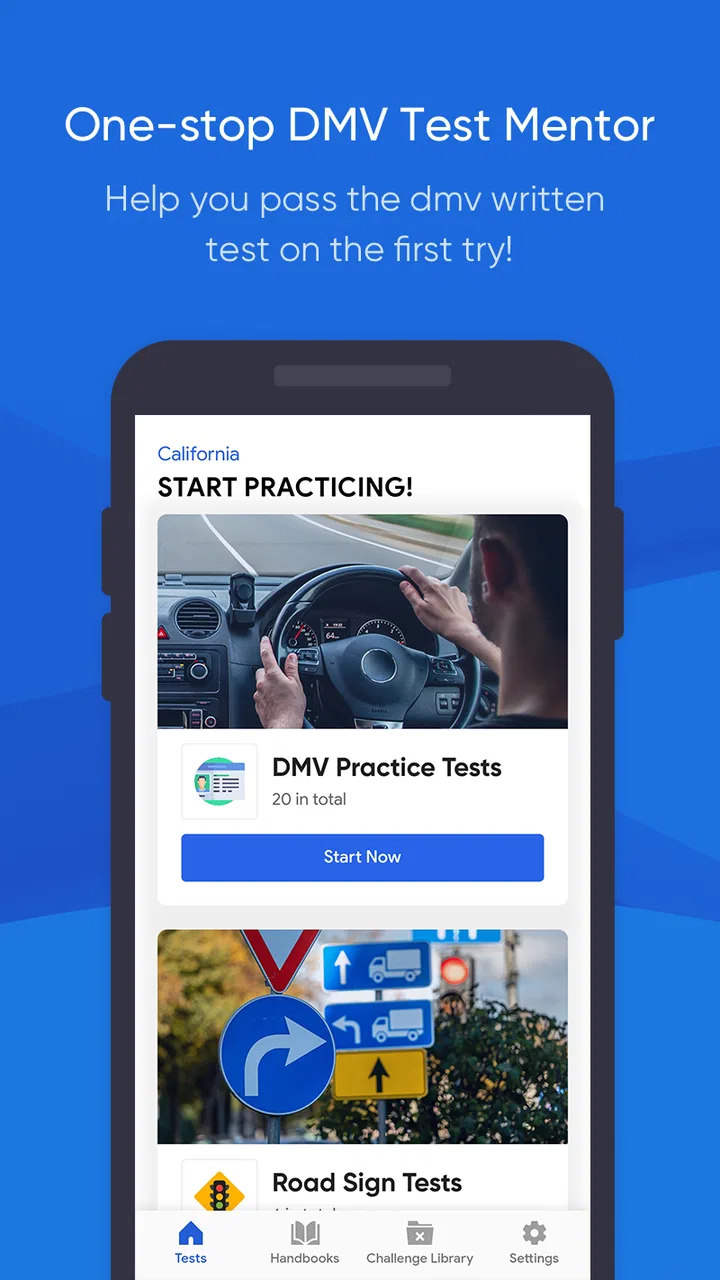
Studying for a driving permit can feel strangely difficult: the handbook is full of rules, exceptions, signs, and state-specific details, while the actual test expects you to recall them under pressure. I found DMV Practice Test Pro 2026 useful because it turns that broad reading task into shorter practice sessions. It is a free Auto & Vehicles app from PPXTech, designed around state-specific DMV permit preparation rather than general driving entertainment.
My first impression was that its value depends less on using it for a long time and more on using it with a sensible routine. Opening it once and tapping through questions is easy, but that approach can create false confidence. The better experience comes from treating each session as a small diagnostic: answer carefully, notice where I hesitate, then return to the handbook or repeat the relevant material before moving on.
The app is available to an Everyone audience and supports devices running Android 7.0 or later. Its current version is 1.3.6, and it has passed the early-adoption stage with over 100K installs. That does not guarantee that every question will match the wording used by a particular DMV office, but it does make the app a practical starting point for learners who want structured repetition without paying for a course.
You May Also Like

 Google Keep - Notes and lists
Google Keep’s Quiet Growth Shows the Appeal of Simpler Notes
As mobile work gets busier, Google Keep keeps winning a simple contest: capture a thought quickly, find it later, and get on with the day.

 Blood Strike: 2.5 Anniversary
Blood Strike’s Loadouts Turn Every Drop Into a Tactical Gamble
A close look at Blood Strike’s custom loadouts: how fast access to signature weapons reshapes its battle royale rhythm, rewards preparation, and narrows the gap between fights.

 Pandora - Music & Podcasts
Pandora’s Music Is Easy to Start, but Harder to Recover
Pandora’s strength is its low-effort path from a seed to a station. Its weak spot is how much confidence it asks you to place in connection, setup, and quiet recovery.

 8 Ball Pool
 Is Built on Rivalries, Rematches, and Routine
A close look at the rivalries, rematches, shared routines, and unanswered safety questions that turn a quick pool match into a persistent mobile community.

 Samsung Music
’s Quiet Strength Is Playing What You Already Own
Its reach comes less from spectacle than from dependable access to a personal library. That simplicity is both the app’s strongest retention engine and its ceiling.

 AccuWeather: Weather Radar
AccuWeather Review: A Quick, Clear Forecast for Everyday Decisions
For everyday plans, the best forecast is the one you can understand quickly. AccuWeather makes rain timing, radar, and local conditions easy to act on, with a few trade-offs.
More From Our News Desk



How I used the practice workflow
I began by selecting the state-specific preparation path that matched the permit I was working toward. That step matters more than it may seem. A question about a road sign or safe following distance can be broadly familiar, yet the details that appear in a permit exam are tied to the rules of the relevant state. I would not use a generic national quiz as a substitute for making that selection correctly.
My basic session was deliberately short. I answered a group of questions without looking up every doubt immediately, then reviewed the mistakes while the reasoning was still fresh. This is more useful than stopping after each uncertain answer, because it reveals whether I actually understand a rule or am simply recognizing a familiar phrase.
A realistic use case is a learner who has a test appointment coming up and only has a few minutes during a lunch break or while waiting for a ride. In that situation, the app is easier to fit into the day than a full handbook chapter. I would complete a focused session, write down the topics that caused trouble, and use the official manual later for clarification. The app becomes a practice layer rather than pretending to replace the source material.
The most effective habit is to review mistakes as lessons, not as failures. If I repeatedly miss questions about right-of-way, I do not simply keep pressing through more questions. I pause and identify the underlying confusion: perhaps I am mixing up an uncontrolled intersection with a stop-controlled one, or remembering a rule without its exception. That small change in method makes the practice more transferable to an unfamiliar question.
Choosing the right pace for learning
There are two tempting but weak ways to use a permit-test app. One is rushing through questions to see a high result. The other is memorizing the answer position or wording. Both can break down when the exam presents the same rule in a different situation. I got better value by reading every option, explaining to myself why the correct answer was safer or legally appropriate, and only then moving on.
For a beginner, I would start with untimed practice and focus on understanding. Someone who has already read the manual can use the app more aggressively as a recall check. Near the test date, short repeat sessions are preferable to one exhausting study block because they expose whether the knowledge remains available after a break.
This workflow also answers an important question: can the app replace the DMV handbook? In my view, no. Practice questions are excellent for retrieval and for showing where attention is weak, but the handbook remains the better authority for exact wording, local exceptions, required documents, and official procedures. The app is strongest when placed between reading and testing, not used as the only source.
Settings and preparation choices worth checking
The most important “setting” is the state and permit context chosen at the start. I would check that before every serious study cycle, especially if a family shares a device or if someone is preparing in a different state after moving. A correct answer in one jurisdiction may not be the answer expected in another, so the state selector is not a cosmetic choice.
I would also check the device itself before relying on the app during a final review. Since it supports Android 7.0 and newer, compatibility should be straightforward on many older phones, but keeping the application updated is still sensible. The listed version is 1.3.6, so a learner should make sure the installed copy is current rather than assuming every device has the same build.
Another useful preparation choice is deciding whether a session is for learning or simulation. During learning sessions, I allow myself to slow down and investigate mistakes. During simulation-style sessions, I avoid interruptions and answer as if the result mattered. Mixing those purposes can make the score hard to interpret: a relaxed learning result is not the same measure as performance under pressure.
I would keep a simple external note of recurring topics instead of trusting memory alone. The note does not need to become a second study system. A few headings such as signs, intersections, parking, defensive driving, and penalties are enough to show patterns across sessions. This is especially useful when several wrong answers look unrelated but are actually caused by one misunderstood principle.
There is also a practical accessibility consideration. Reading every question on a small phone can be tiring, particularly when the wording is dense or the learner is studying late. I found it better to use normal screen brightness, take breaks, and avoid treating fatigue as evidence that I have mastered the material. A tired learner may tap the familiar answer rather than process the scenario.
Faster patterns that improve recall
Once the basic workflow feels comfortable, I use a three-pass pattern. The first pass is for honest answers. The second is for reviewing only the questions I missed or answered with low confidence. The third is a delayed check later in the day or the next day. This exposes the difference between immediate recognition and durable recall without requiring a long study session.
A second pattern is to group mistakes by cause rather than by question. For example, if I miss one item about yielding and another about turning, I ask whether both involve failing to identify who has priority. If so, I study that shared idea instead of memorizing two isolated answers. This makes the app more valuable than a simple collection of flashcards.
I also avoid changing an answer merely because another option sounds more detailed. Permit questions often reward careful reading, not the longest sentence. I look for the action that follows the rule described in the scenario, then compare it with the alternatives. This habit reduces guessing based on wording and prepares me for questions that use unfamiliar examples.
For a learner with limited time, I would use a rotating schedule. One day can emphasize signs and markings, another can focus on intersections and right-of-way, and a later session can mix everything. The mixed session is important because the real exam will not announce the topic before each question. Specialization helps repair weak areas; mixing checks whether the knowledge survives without a hint.
Another non-obvious trade-off is score interpretation. A strong result after seeing the same questions repeatedly may show familiarity with the app rather than readiness for the DMV exam. I would regard repeated high performance as encouraging only when I can explain the rule and handle a differently worded scenario. If I remember the correct option but cannot explain why it is correct, I would return to the official material.
Where the app helps, and where its limits matter
The app’s main strength is convenience. It gives a learner a focused way to practice permit-style knowledge without carrying a book everywhere. It is also free, which lowers the barrier for someone who wants to test a study method before paying for a larger course. The 4.1 average from 472 ratings suggests that many users find the approach useful, while the 161 written reviews indicate that people have taken time to comment on their experience.
Still, I would not confuse popularity with completeness. A practice app can only help with the material it presents, and a learner may overlook a subject simply because the questions feel easier there. The app also cannot observe how someone drives, correct poor habits behind the wheel, or explain every personal situation a new driver may face. It prepares the knowledge side of the process, not the practical driving lesson.
This is where the usual alternatives have an advantage. The official state handbook is slower to study but authoritative and comprehensive for local rules. A driving instructor can explain why a maneuver is unsafe and adapt the lesson to the student. A paid course may offer a broader learning path or additional support. I prefer this app over those alternatives for quick repetition and self-testing, but not as a replacement for official reading or supervised practice.
Someone who already knows the handbook thoroughly may find the app too basic if they want advanced explanations, detailed progress analytics, or instructor feedback. Likewise, a learner who struggles with reading-heavy questions may need a person to explain the rule in different words. In those cases, the app can still be a supplement, but it should not be the only tool.
State selection deserves one more warning because it affects the entire study result. If the wrong state is chosen, a learner could confidently practice material that does not apply to the upcoming exam. I would verify the state before beginning and compare uncertain rules with the current official handbook. That extra minute is more valuable than completing another round of questions.
Privacy and cost are also simple decision points for me. The app is free, so there is no purchase decision blocking access. The Everyone rating makes it suitable for a broad audience, including younger permit applicants, although parents should still encourage handbook reading and supervised learning rather than presenting quiz scores as proof of readiness.
Who should use it before booking the exam
I would recommend it to a first-time permit applicant who wants a low-pressure way to discover weak areas, to a busy learner fitting study into small gaps, and to someone who has read the handbook but needs repetition. It is particularly useful when motivation is the problem: answering a few concrete questions feels more manageable than facing an entire manual.
I would be more cautious recommending it to a person who has not identified the correct state requirements, someone expecting guaranteed exam questions, or a learner who wants behind-the-wheel instruction. It is also not the right sole resource for people who need individualized explanations. The app can show that an answer is wrong, but the learner may still need the handbook, an instructor, or another trusted explanation to understand the reason.
Before scheduling the exam, I would complete several sessions separated by time, review every recurring mistake, and then read the relevant handbook sections. I would not judge readiness from one unusually good attempt. A better sign is consistent understanding across mixed topics, including questions that do not look familiar.
Because the app runs on Android 7.0 or later, it can suit people using an older phone, which is helpful for families handing down devices to new drivers. I would still study somewhere quiet and keep the phone charged; convenience works best when it removes friction rather than adding distractions.
My verdict after building a repeatable routine
DMV Practice Test Pro 2026 is a useful, free companion for permit preparation, especially when I use it as a diagnostic tool instead of a shortcut. PPXTech has focused the app on a clear everyday need: practicing state-specific DMV knowledge in manageable sessions. Its 4.1 average and over 100K installs give it a credible place among accessible study options, but they do not remove the need for careful preparation.
My preferred routine is simple: select the correct state, practice without rushing, record recurring weaknesses, return to the handbook, and repeat the mixed review after a delay. That workflow makes the app more effective than endless random tapping. It also protects against the biggest mistake in permit preparation—mistaking familiarity with quiz screens for genuine understanding.
If you want a free way to rehearse rules on an Android phone, I think it is worth trying. If you need official legal guidance, personal coaching, or practical driving feedback, pair it with the appropriate alternative. Used in that balanced way, it earns its place as a convenient study partner rather than an exaggerated promise of exam success.
FAQs for DMV Practice Test Pro 2026
01What is DMV Practice Test Pro 2026 and how does it work?
DMV Practice Test Pro 2026 is a mobile app designed to help users prepare for their driving license exams. It offers a wide range of practice tests that mimic actual DMV test questions. The app provides detailed explanations for each answer, allowing users to understand their mistakes and improve their knowledge before taking the real exam.
02Is DMV Practice Test Pro 2026 available for both Android and iOS devices?
Yes, DMV Practice Test Pro 2026 is available for download on both Android and iOS platforms. Users can find the app on the Google Play Store for Android devices and the Apple App Store for iOS devices, ensuring accessibility for a wide range of smartphone users.
03Are there any in-app purchases or subscriptions required to access all features?
While DMV Practice Test Pro 2026 offers a range of free features, there may be in-app purchases or subscription options to unlock additional content or remove ads. These purchases can provide users with more comprehensive practice tests, advanced analytics, and personalized study plans to enhance their preparation efforts.
04How accurate and up-to-date are the practice tests in DMV Practice Test Pro 2026?
The practice tests in DMV Practice Test Pro 2026 are designed to closely replicate the questions found in actual DMV exams. The app regularly updates its database to reflect the latest changes in driving laws and regulations, ensuring users are studying the most current information available for their specific state.
05Can DMV Practice Test Pro 2026 track my progress and help identify areas for improvement?
Yes, DMV Practice Test Pro 2026 includes features that track a user's progress over time. The app provides analytics on test performance, highlights strengths and weaknesses, and suggests areas for improvement. This personalized feedback helps users focus their study efforts effectively, increasing their chances of passing the DMV exam.
Pros
- User-friendly interface enhances study experience.
- Extensive question bank covers all topics.
- Real-time progress tracking boosts motivation.
- Offline mode available for study anywhere.
- Frequent updates ensure current information.
Cons
- Limited customization for practice tests.
- Ads may interrupt the study flow.
- Requires in-app purchases for full access.
- No support for multiple languages.
- UI can be cluttered for new users.

DMV Practice Test Pro 2026
Gallery